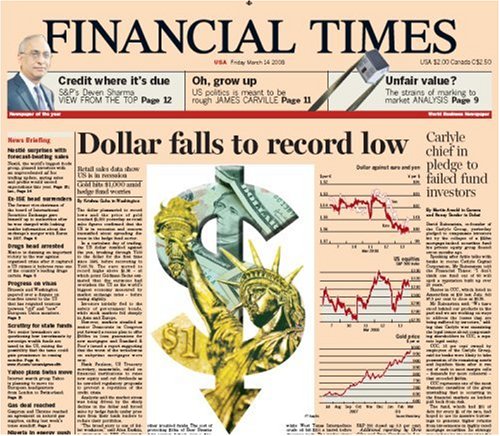
As seen in Financial Times

For those of you (like myself) that don’t closely follow the world’s top financial newspapers, the easiest description of the Financial Times is that it’s a British Wall Street Journal.  It’s one of the best newspapers of it’s type in the world.  For that reason I was very pleased to be interviewed by one of their writers a few weeks ago about my favorite topic and even more pleased that they published the article complete with a link to our humble little blog barterfantic.com.

You can read the full article at the link below.  It’s behind a “paywall” but you can get free temporary access by completing a short form.

http://www.ft.com/cms/s/0/6da4934a-121a-11e2-b9fd-00144feabdc0.html#axzz28vYMpLpI

Here’s a short excerpt:

Oct 10, 2012
The art of good bartering
By Alicia Clegg

With his twins about to start middle school, Brian Petro, owner of Bright Productions, a Californ­ian web development business, faced a dilemma: how to pay for their education without draining the family finances. His solution? Barter.

A month or so on, he says, his sons are doing fine. The school is happy too. In lieu of fees, Mr Petro is redes­igning its website and has procured $1,000 worth of art materials for the school by bartering his services with a local store: “Bartering allows us to go on vacation, maintain our cars better and educate our kids privately.”

Mr Petro, who has a blog, Barterfanatic.com, is not a lone enthusiast. Businesses have always bartered, of­ten as a way of overcoming liquidity problems or bypassing currency re­strictions. But according to the International Reciprocal Trade Association, a US-based body, the recession has encouraged more companies to offset the effects of shrinking order books and tight access to credit by putting excess capacity to use…

Please use the link above to continue reading the article.

Pop Culture is wrong about Barter

This is the red paperclip that Kyle MacDonald started with on his bartering adventure.  Some of you may have heard about it because it was very well publicized.  Back in 2005 he started making trades with this paperclip and he ended up with a house.    You may have also seen the TV show Barter Kings that has been on for a year or so now that shows the hosts trading low valued products/services for those of higher value.  I have a bone to pick with these stories.  It’s not that the stories aren’t true…I’m sure they are.  My issue is that these are the stories that are now ingrained into pop-culture about how barter works.   This is what people outside of the “barter sub-culture” think barter is all about.  And… it’s TOTALLY UNTRUE.

Barter is NOT about finding a way to create an un-equal trade.  Barter is about making trades of equal value.  It’s not that traders are slick salespeople that out-negotiate or trick their barter partners into a deal that benefits one party more than the other.   In “the real world” of barter, the value of the products/services for trade is usually pre-established.  The benefit of the trade isn’t that you receive something of greater actual value, but that you receive something of greater value to you specifically.  More than anything else this personal value usually has to do with supply.  For example, if I have more chewing gum than I could ever use or sell, I might be happy to trade some of it for something I didn’t have like candy bars.  Because I traded $1000 worth of gum for $1000 worth of candy bars, from an accounting point of view there was no profit, but none-the-less, the trade greatly benefited me.

There is profit to be made in barter, but it is earned EXACTLY the same way it is in the cash world.  You can make a profit on a trade if you can acquire the product/service that you are trading at below market value.  The most common way to do this is by buying wholesale or by producing the product/service yourself at costs that are lower than retail value.  For example, because my business is web development, I produce websites at my wholesale costs, then trade the service at retail value to someone that would not have been able to hire my firm for cash.

So…you might ask, how did Kyle MacDonald trade a paperclip up to a house?  The answer is quite simple.  He was trading more than just a paperclip.  He was selling an adventure.  He was selling a story.  People that were bartering with him were willing to make trades that appeared not to benefit them because being part of the story held value to them.  The same is true for the Barter Kings TV show.  I would encourage you to enjoy these types of stories but keep in mind that REAL barter is about the exchange of goods/services of equal value.

Major upgrade to IMS website

IMS rolled out a major upgrade to their website today. I haven’t gone through everything yet, but it looks like there is some really good stuff in there.

* On most search results pages (like the marketplace for example) you can choose how many results you’d like to see.
* Marketplace images are now larger. It doesn’t look like you’ll need to re-upload images if you posted large images pre-roll-out.
* Bugs in transaction history “pagifying” have been fixed.

I haven’t tested yet, but I’m hoping that this upgrade also included real-time transactions. Previously it would often take a day for transactions to show up on the website. IMS technical staff in the past said this was something they were working on so I’m guessing that it was included in this roll-out. I’ll find out for sure next time I post a transaction.

I’m still seeing some new roll-out bugs, but that is to be expected with such a big upgrade. I’m sure they will sort it out in a few days. If you are having difficulty with the site in Chrome, give Firefox a try.

How to barter for private school

My twin boys are in 5th grade this year.  Because the school that they were going to last year only goes to 4th grade, my wife and I needed to find a new school for them this year.  We knew that we wanted to send them to a private school, but we also knew that we didn’t have the cash to do so.  This is how we successfully found  a great school for them 100% on barter.

  1. First we put together a list of requirements for school prospects and found schools that fit our requirements.
  2. We called up all of the schools on our list toward the end of last school year and asked to get a tour from the principal and for our boys to have a “shadow day” at the new schools.  This got us a good feel for the school and gave us an introduction to the principal.
  3. We then put together our final list of schools all of which we thought would work for our boys.  We ended up with 3 contenders.
  4. I then put together an email to each of the principals.  I requested that the principals share the email with their school board.  It explained that we are interested in their school and  that we would like to pay the tuition in barter.  I gave a sample list of products/services that we’d be able to provide.  I was also clear to point out that there was almost no additional cost to the school by enrolling my kids.  I explained that the school would have a credit with me for the total amount of tuition (about $10k for 2 kids) and that the balance would decline as I provided products/services throughout the year.
  5. Of the three schools, one was interested in a trade.  I was invited to present my idea to their school board and they accepted.  My boys started school 3 weeks ago and everything is going great.


As I’ve noted before in this blog, some people “get” barter and some people don’t.  That was the problem with the schools that declined my offer.  Instead of understanding that I wanted to pay the full tuition, they would offer for us to apply for financial aid.  There was also a concern that our deal might make other parents that volunteer, unhappy.   I tried to explain that the types of things I could provide on trade were generally not the type of things that folks could volunteer to do, but that mostly fell on deaf ears.  The craziest objection I heard was from a school board member that insinuated that if we weren’t paying cash we wouldn’t be as committed to the school.  I’m afraid the joke is on him because as we all know, barter relationships are much more involved and comprehensive than cash ones.

It was a lot of work to set up this deal, but I’ve been really pleased with how it’s been going at my boy’s new school.  My goal now is to make sure the school board is happy with the deal so they will be open to it in future school years.  I’ve applied to join the school board because I think I will be more effective at finding good ways for them to spend their barter if I’m more involved in the school’s inner-workings.

The politics of barter

As a barter fanatic that is politically conservative I find myself sadly disappointed in my fellow right wingers and their lack of interest in barter.  But I’m starting my story at the end instead of the beginning.

It all starts a couple years ago when I started bartering as a business strategy.  I live in California which is of course known for it’s liberal leanings.  Within this generally liberal atmosphere there are also pockets of folks that lean even further to the left.  That is the case with a town about 15 miles from my home town.  It’s proud of it’s leanings to the far left, has a sign on the way into the town declaring it a “nuclear free zone,” and it has a greater share of vegetarian restaurants than anywhere I’ve been (all tucked neatly between the organic wholefood stores, the smoke shops, and the yoga studios).  Of course I was (and still am) happy to barter with anyone regardless of their political affiliation.   But a funny thing happened over the years.  Even though I happily traded with all comers, I continually found that a significantly larger percentage of my trades happened with business in this extremely liberal town than anywhere else.  Although I’ve lived in the same county for almost my whole life, historically I’ve never spent much time in this town, but now I find myself constantly in this town to work with clients/vendors that I barter with.  Keep in mind that the barter exchange I use  the most is in my home town, not this neighboring town I’ve described.

I can’t help but come to the conclusion that liberal folks are more pro-barter than right wingers.  Based on the huge volume of evidence that I have, I can’t come to any other conclusion.  Where it becomes interesting is trying to figure out WHY.  I currently have a multi-pronged theory about this.  My conclusions are totally unscientific and cannot be proven, but I think they are worth considering.  Here’s what I came up with:

  1. Liberals are more open to out-of-the-box ideas like barter than conservatives.
  2. Liberals feel that big business is evil.  Barter is intrinsically folksy and relationship based.  It is true that giant multi-national companies barter, but for the most part the companies that you and I are most likely to barter with are small.  I think that liberals feel that barter brings “power to the people” and that by using trade they are “sticking it to The Man.”
  3. Liberals unconsciously (or maybe even consciously) think that money is evil.  I think that somewhere in the backs of their brains  liberals think that physical currency, the green-backs themselves are dirty and will somehow defile them.  So…the idea of commerce w/o cash is very appealing.

What is the take-away here?  What is there to learn?  Honestly I have no idea.  This article is just my observations.  Am I crazy?  Have you readers run into this too?  Please comment back and give me your feedback.

You have to spend money to make money

I don’t know about you, but my Dad always said you have to spend money to make money.  Certainly this axiom holds true as I’ve tested in the “real world.”  Before you can sell your inventory you have to buy it and and before you can buy it you have to have somewhere to put it and it goes on and on.  Business people understand this and don’t generally fret too much about it if they have suitable cash-flow.

That being said, I find that a lot of folks that are new to barter somehow think that when they trade they can get something for nothing.  They are surprised that they are expected to spend some of their hard earned cash to earn barter credits.  In the last couple weeks I ran into this twice.  Once was with a shop owner that was looking at cutting back on barter because her exchange fees were costing her a considerable amount of cash.  With the other example, I had a potential direct barter client who didn’t want to barter for the materials portion of a project I wanted to hire him for.

For both of these people I have the same advice….you have to spend money to make money.  It’s the same in the barter world as it in the cash world.  When I trade with someone I have to spend cash to either buy product or pay my staff.  Either way I am spending cash to earn barter credits.  When I barter with you I expect you to do the same thing.  The key of course is to know if that exchange is to my advantage or not.  If I spend too much cash to earn barter credits or if I don’t spend the barter credits (regardless of their cost) then it’s a failed deal.  On the other hand, if I earn the barter credits with a relatively low cash cost and I know how to spend the credits then I am way ahead of the game.

How to reignite a client with barter

I supposed every established business has them.  Lost sheep.  Good loyal cash clients from the past that have wandered away.  It’s not that they hired someone else to work with them.  They’ve simply been short on time, money or both.  It’s been years since you’ve worked with them and even though you’ve checked in with them every once in a while, it doesn’t seem likely that you’ll be working for them again anytime soon.

Take heart!  The solution is barter.  Although I would normally not recommend to switch a cash client over to barter, in extreme situations when it looks like you’ve lost a good cash client you should give barter a try.  I specifically recommend offering to work on a specific project for them on barter with the intent of reintroducing your services and moving them back to cash after the project is complete.  I’ve done this twice recently and this is how it worked:

1)  Many years ago I built a site for a good local painter.  A lot of time had passed and their site really needed an upgrade but it just wasn’t a priority for them.  When my wife and I decided we wanted to paint our house, we gave this client a call.  They were happy to do the painting for us in trade for credit to work on their website.

2)  My very first web client 17 years ago is a used office furniture dealer.  Much like the painter, they needed work on their website but it wasn’t important enough to them to get the ball rolling.  A barter client of mine mentioned they needed some furniture for their new office.  When I gave my old furniture clients a call they said they would be happy to provide whatever future is needed in trade for my web services.

Although I would advise caution when considering bartering with a cash client, I have to say that I don’t at all feel like I’ve lost any cash business with these deals.  They hadn’t done any cash business with me for years.  I had nothing to lose.  Plus I think there is a very real chance that when they have new work done and have spent all the barter credit they have with me, that they will go back to cash.  It’s been long enough that they don’t remember the value of my services.  Once they are reminded through our one-time barter deal they could loosen their cash purse strings.

Barter Reciprocity

As many of you know, there can be times when you consistently earn more barter credits than you spend and you need to take a break from earning more.  In those times I continue to service my existing barter clients, but stop taking on new ones.

That being  said, even when I’m not looking to pick up new barter clients, I make an exception for folks that I’m already purchasing from on barter.  For example,  I have been avoiding taking on new barter clients lately in a particular exchange, however, when the drycleaner that I use (from that exchange) asked me about working for him on trade, I took him on as a new client.  It just wouldn’t be right to spend barter credits with a vendor, but not accept them as payment from the same party.

Conversely, if I work for you on barter, even if you are not taking barter from other members, I fully expect that you should accept it from me.

Too much barter?

Last article I mentioned that one of my favorite ways to spend barter is on my kids. I love the fact that I can give my kids just about anything that is on barter. I hate the fact that they know it. Entitlement. It’s a very ugly word. And it’s oh-so-easy for kids to feel entitled to whatever they want if you set the pattern.

Honestly I’m in uncharted territory here because historically my kids haven’t felt entitled to anything. I don’t even give them an allowance. They have their own small businesses and earn their own spending money. But when I talk to them about how an expensive summer camp was that we sent them to (see my last article), they are very causal about it. They say it was fun and that they guess they would like to go again in the future. They also talked about how long they had to wait around for lunch and that the pool was cold. Give me a break! When I was a kid, we did a Polar Bear Swim at camp where the whole point was that it was fun to freeze your butt off!

I haven’t decided quite how to handle this one yet but I’m pretty sure the correct solution has something to do with earning privileges rather than handing out the good-stuff to my kids simply because it’s on barter. Maybe I need to set them up in business earning the barter credits that they want to spend. That’s food for thought. More later.

Summer Camp!

One of my favorite ways to spend barter credits is on my kids. Over the years there have been MANY activities that my kids simply couldn’t have done if it were not for barter. This summer is no exception. The camps that my kids are looking at are all on barter and are as follows:

  • Traditional Summer Camp (swimming/hiking/zip lines/horses/crafts/etc)
  • Fencing Camp (foils, not 2×4’s)
  • Karate Camp
  • Art Camp
  • Sports Camp (basketball, touch football, etc.)
  • Racing Camp (indoor Kart racing)


All of these camps are within 15 miles of our house.  I suggest that you check around and see what is close to you.  If your broker doesn’t have anything appropriate, let your fingers do the walking.  Start calling local camps and see if they want to add your kids to their schedule on trade.  Sure, you’ll get plenty of “no’s” but occasionally you’ll get a “yes” that makes it all worth it. Don’t forget that most businesses that offer children’s classes offer camps during the summer even though you might not usually think of that business as a “camp.”