How much is too much barter?

So….how much barter really is too much?  Ultimately that is an indiviual question.  I’ve heard people in the industry throw out recommended percentages as rules of thumb… 5% of your total sales; 10%, 15%.  It’s nice to have a number to put out there for newbies but I really question the accuracy of any general number like that applied across the board.

First off I should point out that 99% of the traders out there that think that they can’t handle more trade are probably wrong.  It’s not that they have too much trade, it’s that they are not good enough at trade to take advantage of more trade than they are currently conducting.  I don’t mean this as an insult.  It applies to myself as well.  Right now I have more of one partcular barter currency than I need and I’ve (for the most part) stopped accepting that currency.  Does that mean that I have too much?  Maybe.  Or it could mean that I simply have not yet figured out how to use that currency to my advantage well enough.

Occasionally I hear a story about someone who supposedly lives on 90 to 95%  barter income.  Frankly I find this very difficult to believe.  As much as I love barter,  there are some things that you have to pay for in cash.  Taxes for example.  The IRS won’t take a chicken as payment.  Plus, trying to barter for absolutely everything you need would be a lot of work.  I’m not convinced that one person would have enough time to in  a normal work week to find all the trades they need to make it on 95% barter income.  I’d also point out that because setting up a trade takes a while, even if you have enough time in your week, that doesn’t help you with an immediate need you might have in the next hour.

I just checked over my records for 2010 and it looks like about 35% of my income was on trade.  I don’t know about you, but that number is a little scary to me.  I love to trade, don’t get me wrong, but it is unsettling to me that I am that dependent on barter.  It means I really need to be motivated to find good trades for things that my family needs.  If I don’t find those trades, my income goes down substantially.

Of course, it’s not like I’m decreasing my cash sales in order to take on barter sales.  All barter sales are in addition to the cash sales I was going to do anyway.  So from that point of view, the percentage doesn’t really matter.  Barter does not replace my cash slice of the pie.  It helps me have a bigger pie.

I realize it’s a somewhat personal question, but I would be very interested if folks would post back a comment on this article and let me know what percentage of their income is in barter and how they feel about that number.  Feel free to post autonomously.

Top Misconceptions about Barter

There are a couple recurring concepts that I’ve run into about barter that I’d like to address.  For those of you that have been around the block, you already know these.  That being said, I hope this article will still be valuable as you can refer the uninitiated to it.

  1. Barter is NOT a tax dodge
    The IRS does not mind if you barter at all.  That’s because all of your barter income is taxable.  You are expected to report all barter sales on your income taxes.  This on is a slam dunk as far as documentation goes.  Here is a direct quote from the irs.gov website:
    Topic 420 – Bartering Income
    Bartering occurs when you exchange goods or services without exchanging money. An example of bartering is a plumber doing repair work for a dentist in exchange for dental services. The fair market value of goods and services received in exchange for goods or services you provide must be included in income in the year received.
    Generally, you report this income on Form 1040, Schedule C , Profit or Loss from Business. If you failed to report this income, correct your return by filing a Form 1040X. Refer to Topic 308 for Amended Return information.
  2. Barter is not illegal
    It may surprise you to hear that some folks out there actually think that bartering is illegal.  Usually this idea in some way is related to taxation.  I guess the belief is that some government agency has banned barter as a way to stop folks from skipping out on their taxes.  This is totally untrue.  Barter for any legal product or service that I’m aware of is totally legal.  What IS illegal is tax evasion.
    It’s not just income tax that can be an issue.  I once ran into a small farmer that I wanted to trade with that was convinced barter was illegal.  After asking some questions I figured out what the actual problem was.  Some years back they had traded produce for labor on their farm.  When this worker became unhappy with them they got into a lot of trouble for illegal labor practices.  The farmer failed to understand that the problem was not barter.  The problem was that this person was an employee, but they failed to follow local labor laws for this person.  It is perfectly legal to hire an employee and pay their net pay on barter, but you still have to pay state and local taxes and withholding in cash as well as have worker’s comp insurance ect. etc.
    I also find it interesting that even seasoned barter professionals often hold unfounded beliefs that certain industries are banned from barter.  I’ve been told by veteran barter professionals that industries like insurance, investment brokerages, and firearms sales all have special rules that limit or ban barter .  The problem is that every time I dig into the topic I can never find one shred of evidence either in statute or common law prohibiting or limiting barter in specific industries.  Of course I should point out that I’m not an attorney.  Please post back if you are an attorney and have some new information for our readers on this topic!

It’s important to understand these issues because part of your job as a good trader is to recruit new trading partners.  As you do that you will without a doubt run into the above objections and you need to be ready to answer them.  Of course now you can also give them a link to this article!

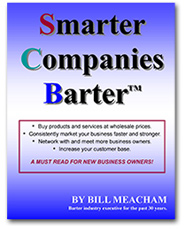
Review: Smarter Companies Barter

Hopefully this is the first of many books to come that I will review on the topic of barter.  I heard about this book through a fellow barter fanatic who recommended it to me.  It was written by Bill Meacham of BancMarc who is a 30 year veteran in the industry.  I traded some emails and phone calls with Bill and he proved to be a wealth of information about all things barter and generously offered to send me a copy of his book for review.

Smarter Companies Barter is an 80 page self published book that is a quick read even for speed-challenged readers like myself.  What it lacks in polish it more than makes up for in passion.  The book explains the value of a modern barter exchange to the uninitiated, really hammers on the importance of ethics for all parties involved in barter and does a good job reminding folks that run barter exchanges of how to run a tight ship.  A recurring theme in the book is the importance of member education.  One potential use for the book is for exchanges to give it to new members as part of an educational program.

I have to admit that the book did lead me to question one of my own trading practices (more on that later).  It’s an unusual book that motivates me to make changes in my own life so I have to give this book my recommendation.

If you want to buy a copy of Smarter Companies Barter it is available at www.smartercompaniesbarter.com.  Ironically it is not available on barter at the time of my publishing this article.  I would also like to note that the author has mentioned the idea of sponsoring this blog.  That possibility has not influenced my review in any way, but I’m afraid you’ll need to take my word for it.

Creating your own barter currency

A great way to improve cash flow and decrease accounts receivable is to create your own barter currency.  This can be as simple as issuing gift certificates.  You might be amazed how many people you do business with might accept these as payment.  Of course this will always be easier with new vendors rather than ones that already expect cash from you.  It’s as simple as asking the person with authority if they would accept your gift certificates as payment.  Your barter exchange may also be willing to purchase gift certificates from you.

Of course, some services would be better suited than others for this type of trade.  For example, my primary business is web development.  Although the vast majority of businesses need a website, many of them already have a vendor in place and a website isn’t a consumable item that you need to re-purchase every month.  Not to worry if you are in that situation.  Here’s a cool twist on this classic concept:  You can use other people’s gift certificates as your own barter currency too.  For example.  My firm does web development with an online grocery store that specializes in organic food delivered to your home.  Because absolutely everyone has to eat, this is a perfect barter currency.  Right now I’m negotiating with a local butcher shop to build their website and I’m hoping to do the same thing with them.  My family does not need thousands of dollars worth of steak, but I sure do have a lot of friends in my barter network that would love to get their hands on some gift certificates for meat from this shop.

The one part I still have to work out is the actual certificates that will be used if I make a deal with the butcher shop.  Currently I’m thinking that I will have numbered scrip printed up for the butcher shop which each piece of scrip worth $10.  I can have them printed for the shop (on barter of course), they will pay me with them, then I will trade them away when I buy other items through my barter network.  The butcher shop is a big winner too because they will have many new customers come through their shop.  Hopefully once they spend their scrip they will come back and spend cash.

Of course I should mention that (regardless of what you use as currency) all sales need to be reported to the IRS.  Additionally, make it clear on your scrip that they are gift certificates and ARE NOT US currency.  None of us want to be talking to the secret service about counterfeiting.

A Barter Mentoring Program

Don’t you wish Yoda would have shown you the ropes when you first started bartering?  There is so much to learn when you first start bartering.  Many business owners are so busy trying to run their own business that they really have no time to devote to teaching themselves how to get the most out of trading.  Additionally many brokers are so over-loaded that they simply don’t spend a lot of time training their members.  The end result:  There are a lot of people that are really bad at barter and there is a much higher attrition rate for exchange membership than there needs to be.

I propose that all barter exchanges develop a formal training/mentoring program.  Everyone gains from having more potential barter partners so everyone should get involved.   My vision is two-pronged:

  1. Exchanges should set up formal group training sessions.  The sessions should include basic training for new members and advanced training for folks that have been around the block and just need some new ideas.  These classes can either be taught by management, brokers or even by advanced members that are paid on barter.  I wouldn’t pay members to attend, but I would have lots of good food/prizes at all the events (all purchased on barter of course).  The events could even have a “mixer” feel to them and be hosted by a member that has products/servcies for sale at the event.
  2. Exchanges should set up a formal mentoring program where advanced members can help newer members one on one.  Mentors could be minimally compensated (on barter of course).  Mentors can help their assigned members find good ways to spend their credits (the most common problem for new members) as well as help with all other aspects of barter.

Please post back if you are familiar with programs along these lines of if you have any suggestions for improvements.

Bartering for firearms

Without getting too much on my soap-box I have to say that I think it is totally ridiculous that many/most barter exchanges have rules against trading for firearms.  The best I can tell these rules are based on either a bias against the second amendment, or fear based on ignorance of the law.   Seeing that it seems unlikely that the barter exchanges will see the light any time soon all the firearms I’ve bartered for have been direct trades.

Here’s how it’s done:
As with all direct trades the first step is to find a willing trade partner.  In my case, I have a well established web development company.  Seeing that most gun shops need a website, all I had to do was contact enough gun shops offering a trade and eventually I’d find someone who wanted to barter with me.  Once I found a few trade partners, I wrote up contracts to develop websites for them and how much the projects were worth.  The gun shops provided me with a credit in their shop for that amount.  That was all there was to it.  I purchased the firearms exactly the way I would for cash.  I did the background checks and I sat through the “waiting period” and eventually I picked up my shiny new guns.  Perfectly legal.  Perfectly easy.

I haven’t done this, but it’s also easy to trade for firearms from joe-citizen that does not run his/her own gun shop.  In those cases you agree to your trade, then you and your trade partner take the weapon to a federally licensed dealer who conducts the paperwork for you for a small fee.  If barter exchanges were to allow firearms trade, all they would need to do is stipulate that trades aren’t finalized until after the paperwork is completed by a licensed dealer.  Even interstate trades would not be a problem.  Laws about firearms vary from state to state however the dealer will spot any problems along the way so neither the traders or the exchange need to be experts in the industry.

The truth of the matter is that the joke is on the trade exchanges.  They are excluding themselves from profiting from a large group of honorable and perfectly legal transactions.  Maybe I should set up a barter exchange that specializes in firearms trading.  What do you think?

Good things come to those who wait

There are some things that are harder to barter for than others.  Some of those more difficult things to barter for are physical products like construction materials.  For a year or so I’ve been consistantly told that I will not find double paned windows for my house on barter.  Every time I was told this I would smile and say that it can’t hurt to ask.   I am pleased to announce that my new custom-ordered 100% barter windows and sliding glass door will be ready in about two weeks. The supplier is only an hour and a half away so I can pick them up myself and avoid shipping! So….the lesson is to just keep trying.  And with that in mind I should probably remind you all that I am looking for a late model Toyota pickup (4wd).  Yes…..I know….I’ll never find it.

Hiring staff on barter

I’ve often heard the complaint from unsuccessful traders that they can’t pay some of their most important expenses on barter.  If your business is anything like mine, a major expense is payroll and this article is about how I’ve lowered my payroll liability by hiring staff on barter.

The basics:
There are a few basics about hiring on barter that I should get out of the way right off.  Firstly, you of course are still responsible for all taxes, workers comp, and withholding just like you would a cash employee.  Also, in most cases it isn’t practical to try to hire full time staff on barter.  As much as I love barter, I can’t live off it 100% and that’s true for your staff too.  Lastly (and you probably already know this) it’s a pretty tough proposition to switch cash staff over to barter.

So that’s all the negative news; here’s the good news.  It can be very easy to hire new part time staff on barter.  The easiest way to do this is simply to find sub-contractors that can fulfill a needed position in your business that are already in your local barter exchange.  This is exactly how I hired my book-keeper.  He comes in for about 3 hours a week and does all our books.  I’ve never paid him a cent in cash.  Sub-contractors are also easy because you don’t have to worry about taxes/workers comp/etc.

I’ve also hired traditional employees on barter.  When I’ve done that I’ve usually found the employee by posting in the barter section of craigslist.  As I mentioned it needs to be a part time position.  I then pay all taxes/withholding etc in cash, but the net pay is paid in barter.  I have given the staff member the choice of receiving credit in a barter exchange account or having me carry the balance for them so they can use the credit throughout my entire barter network (of multiple exchanges and direct trade partners).  The key to it is that it always has to be a win-win for everyone.  If it’s not a good deal for your employee, then they will not stick around.

Prescription Drugs on Barter

Depending on your medical insurance (or lack there of) the value of bartering for prescription drugs will vary.  In my family’s case, we have excellent insurance, however it has a high deductible which means for the first half of the year I pay cash on the barrel head for all things medical.  So at the beginning of the year, I’m paying cash for prescription drugs.  I’ve been buying perscription drugs on barter for about a year and this is what I’ve learned.

  • Although I have found a number of pharmacies that will barter for prescription medications, they have never been near by.  That means that you are working through the mail.  This is not necessarily a problem, but it does mean that you need to plan ahead.  It also means that it’s unlikely that you will get antibiotics for your children when they have an ear infection.  Bartering for medication is suitable for ongoing treatments that you know about ahead of time.
  • Pricing is not fantastic with barter pharmacies.  Especially if you are used to simply paying co-pays.  If you are bartering for prescription drugs, get ready to pay more than the retail rate.  That being said, I’ve found that when I take into account the wholesale price that I acquire barter credits at, the pricing works.   There are a couple reasons for the high prices:  First off, as with all hard goods that are in demand, it’s pretty normal to pay a relatively high barter rate.  Secondly, it’s generally smaller independent pharmacies that are open to trade.  They don’t have the muscle to negotiate the kind of prices that big chain pharmacies do.
  • While my wife was recovering from major surgery, she was on pain killers that are more strictly regulated than most medications.  I was able to barter for these, however these prescriptions cannot be called or faxed in to the pharmacy.  The pharmacy needs the original prescription.    I would personally recommend that you have all prescriptions like this mailed directly from the doctor’s office to the pharmacy.  That way if it gets lost somewhere along the way, no-one will ever think there was any funny business on your part.
  • Because timing and accuracy are so important with prescription drugs you really have to watch for good customer service.  I’ve worked with two pharmacies.  One was fantastic and the other one was horrible.    Find one you like and really take good care of them.  Pharmacies generally aren’t used to dealing with barter and adding another layer of complication in a business were mistakes are not allowed can be tough.
  • It has not been my experience that pharmacies work with insurance when they are bartering.  What I have done is paid for the drugs on barter, then submit them to my insurance company myself.   Each insurance company while allow a different price for a particular medication and it will probably be considerably less than what you paid on barter.  As I mentioned in my last post…once I hit my deductible, I can submit my receipts to my insurance company and they will send me a cash reimbursement check.

Bartering for medical services

Over the last year and a half I’ve bartered for dental services, physical therapy, chiropractic services, massage therapy and prescription drugs.  Some of this has been direct trade, but a lot of it has gone through one of my barter exchanges.  Here is a quick run-down of what I’ve done and the ups and downs.

Dental Services
My whole whole family goes to a local dentist that is 100% barter through IMS.  What’s really great is that he trades EVERYTHING including all the lab fees.  That’s also what’s bad about the deal because it got to the point where he was considering dropping barter because his cash expenses were so high.  I’ve encouraged him to start charging cash for his out-of-pocket lab fees (like paying for parts with an auto-mechanic) and I’m hoping that we’ll be able to continue bartering him for his services.  Lesson learned:  Watch out for too good of a deal because it can’t last.

Physical Therapy
My wife had major surgery on her neck and she just started physical therapy last week.  She has gone to a highly recommended therapist in the past so we tried to recruit him into a local barter exchange.  He was not interested.  I’m not sure if it was that he’s got a good enough cash business that he doesn’t need trade, if he doesn’t understand barter, or if he simply isn’t interested in jumping through the hoops that come with barter.  Regardless of the reason, he didn’t join.  I spoke with him after that failed and asked if he’d be interested in simply doing a direct trade and that I could access anything in the exchange directly without him having to join.  He did agree to that however it did feel like he was doing it as a favor  to my wife and I rather than because it was a good deal for him.  I really feel bad about that however, my wife really needs this therapy so we’re pushing forward.  I am very grateful that someone as in-demand as he is will trade with us.

Chiropratic services and massage therapy
These were simple transactions through our local exchange.

Perscription Drugs
You know what….this is a whole other article. I’ll come back and give you the details about bartering for perscription drugs soon.

Insurance
It’s important to note that just because you paid on barter for these services, that doesn’t mean that it doesn’t count toward your deductible on your insurance.  If the service provider doesn’t bill your insurance directly, then make sure you submit your receipts yourself.  The beautiful thing is, once you’ve hit your deductible, it is possible to pay for these services on barter, then get reimbursed by your insurance company in cash.  CHA-CHING!!!!