Why you should fill in the blanks on Barter scrip

Many barter exchanges issue scrip that can be used at restaurants that are in the exchange.  Often they come in 10 dollar increments and they have a spot on each to enter your name and the name of the restaurant where you are spending the scrip.  Filling out 10 of these for a $100 tab is a pain and in the past I never could see a good reason why I should bother.   Well let me tell you….I do now.

Recently I got a call from my broker.  She was asking about some script that had been dumped on a local restaurant that doesn’t accept regular barter scrip.  Apparently the customer dropped the scrip on the table and hit the door before the owner realized what happened.  Here’s the kicker though…the scrip has a tracking number on it and it was scrip that I purchased from my exchange.  What’s even more amazing is that the scrip was used at the bar and I haven’t tasted alcohol in over 10 years!  After a bunch of calls and emails my broker and I are pretty sure we figured out what happened.  What we suspect is  that I spent the scrip in a legitimate transaction with a local restaurant that accepts the the scrip, but I didn’t fill out the form on the scrip.  I left it blank.  Then the owner of the restaurant probably gave it to a friend or staff member who then, not knowing how the scrip is supposed to be used, dumped it on an unsuspecting restaurant that doesn’t even accept that type of scrip as payment.  Lucky for me, my broker knows and trusts me and she believes me that it wasn’t me who did the “dining and dashing.”

By at least putting the restaurant’s name on the scrip when you spend it, you can ensure this will not happen to you.  Once that restaurant’s name is on the scrip, only they can turn it into the  exchange for credit.  That is important because it protects you from being blamed when/if someone else abuses the scrip by spending it the wrong place or by not paying the tip/tax in cash as they should.  Also by filling out the scrip you insure that your exchange will get their appropriate transaction fee.

So the take-away here is to fill out those blanks on your scrip.  I know it’s a pain, but it’s worth it!  I learned the hard way.
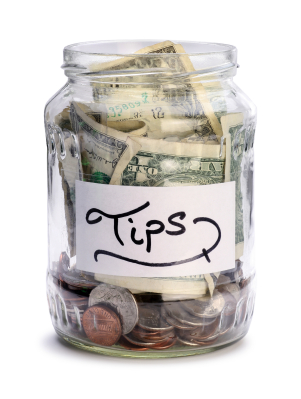
Barter Tipping Redux

It’s extremely important to take good care of your restaurant barter partners and part of that is making sure you leave appropriate cash for tip/tax.  When you are paying with $10 increments of script issued by a barter exchange, figuring out exactly how much you should leave in barter and how much should be in cash can get a little complicated.  A while back I posted some instructions on (what I thought was) a good way to calculate the tip.  I have a new and MUCH BETTER, SIMPLER rule of thumb.  Check it out:

  1. Always overpay for the meal in barter 
  2. Leave 3 times the tax in cash

That’s it!  Is that easy or what!!??  Here’s a practical example:  Let’s say you get your bill and your total is $28 for the meal plus $2.24 tax.

  1. Pay $30 in script (overpaying the $28 meal bill)
  2. Leave around $7 in cash (approx 3 times the tax)

The only exception to this rule is if the bill is only slightly over a ten dollar increment.  For example, if the bill was $32, I would then leave $30 in script (not overpay) but when it comes to leaving the cash I’d leave 3 times the tax PLUS the $2 I didn’t pay in barter.  BUT….if you want to keep it simple,  you are ALWAYS safe to overpay the meal in barter and triple the tax in cash.

OK….say it with me people:  Overpay the meal in barter and triple the tax in cash!!!


Stop whining about commissions!

OK … somebody has to say it so I guess it might as well be me.  Stop whining about paying your barter exchange commissions!

Don’t get the wrong idea.  I’m a fellow trader like most of you.  I do not work for a barter exchange.  I’m just tired of hearing complaints from barter exchange members about paying transaction fees.  Here are my reasons why you should pipe down and smile when you pay your bill to your local exchange.

  1. You should have known about the commission structure before you signed up.  If you didn’t, then shame on you and the exchange.  You have a responsibility to know what you are committing to before you sign up.
  2. Barter should be a profitable thing for you.  If it isn’t, you shouldn’t be doing it!  With that in mind, you should recognize that your commission fees are directly proportional to your usage of the exchange’s services.  That means it’s a GOOD THING when you get a bill from your exchange.  It means you are using the service and making money with it.
  3. Exchanges are for-profit businesses.  If they don’t collect commissions they are out of business and you will have to find all your barter partners on your own.

If you are new to barter and have no idea what I’m talking about here, please check out my barter basics page.

You have to spend money to make money

I don’t know about you, but my Dad always said you have to spend money to make money.  Certainly this axiom holds true as I’ve tested in the “real world.”  Before you can sell your inventory you have to buy it and and before you can buy it you have to have somewhere to put it and it goes on and on.  Business people understand this and don’t generally fret too much about it if they have suitable cash-flow.

That being said, I find that a lot of folks that are new to barter somehow think that when they trade they can get something for nothing.  They are surprised that they are expected to spend some of their hard earned cash to earn barter credits.  In the last couple weeks I ran into this twice.  Once was with a shop owner that was looking at cutting back on barter because her exchange fees were costing her a considerable amount of cash.  With the other example, I had a potential direct barter client who didn’t want to barter for the materials portion of a project I wanted to hire him for.

For both of these people I have the same advice….you have to spend money to make money.  It’s the same in the barter world as it in the cash world.  When I trade with someone I have to spend cash to either buy product or pay my staff.  Either way I am spending cash to earn barter credits.  When I barter with you I expect you to do the same thing.  The key of course is to know if that exchange is to my advantage or not.  If I spend too much cash to earn barter credits or if I don’t spend the barter credits (regardless of their cost) then it’s a failed deal.  On the other hand, if I earn the barter credits with a relatively low cash cost and I know how to spend the credits then I am way ahead of the game.

How to reignite a client with barter

I supposed every established business has them.  Lost sheep.  Good loyal cash clients from the past that have wandered away.  It’s not that they hired someone else to work with them.  They’ve simply been short on time, money or both.  It’s been years since you’ve worked with them and even though you’ve checked in with them every once in a while, it doesn’t seem likely that you’ll be working for them again anytime soon.

Take heart!  The solution is barter.  Although I would normally not recommend to switch a cash client over to barter, in extreme situations when it looks like you’ve lost a good cash client you should give barter a try.  I specifically recommend offering to work on a specific project for them on barter with the intent of reintroducing your services and moving them back to cash after the project is complete.  I’ve done this twice recently and this is how it worked:

1)  Many years ago I built a site for a good local painter.  A lot of time had passed and their site really needed an upgrade but it just wasn’t a priority for them.  When my wife and I decided we wanted to paint our house, we gave this client a call.  They were happy to do the painting for us in trade for credit to work on their website.

2)  My very first web client 17 years ago is a used office furniture dealer.  Much like the painter, they needed work on their website but it wasn’t important enough to them to get the ball rolling.  A barter client of mine mentioned they needed some furniture for their new office.  When I gave my old furniture clients a call they said they would be happy to provide whatever future is needed in trade for my web services.

Although I would advise caution when considering bartering with a cash client, I have to say that I don’t at all feel like I’ve lost any cash business with these deals.  They hadn’t done any cash business with me for years.  I had nothing to lose.  Plus I think there is a very real chance that when they have new work done and have spent all the barter credit they have with me, that they will go back to cash.  It’s been long enough that they don’t remember the value of my services.  Once they are reminded through our one-time barter deal they could loosen their cash purse strings.

Barter Reciprocity

As many of you know, there can be times when you consistently earn more barter credits than you spend and you need to take a break from earning more.  In those times I continue to service my existing barter clients, but stop taking on new ones.

That being  said, even when I’m not looking to pick up new barter clients, I make an exception for folks that I’m already purchasing from on barter.  For example,  I have been avoiding taking on new barter clients lately in a particular exchange, however, when the drycleaner that I use (from that exchange) asked me about working for him on trade, I took him on as a new client.  It just wouldn’t be right to spend barter credits with a vendor, but not accept them as payment from the same party.

Conversely, if I work for you on barter, even if you are not taking barter from other members, I fully expect that you should accept it from me.

How to barter with a mature medical practice

Let’s face it.  It’s a lot easier to barter with a company that is a little “hungry” than a mature business that has plenty of cash.  As such I’ve run into a couple occasions where it was a little difficult to try to trade with long standing successful medical practices.  That being said, twice I have figured out a deal that worked and I want to share my insights about it with you.  Here are the things I can think of that I did that I think helped seal the deals:

  1. Speak directly with the owner and acknowledge their level of expertise.  Point out that you really want to work specifically with them.
  2. Acknowledge their successful practice and point out that you understand that they don’t NEED to barter.
  3. Here’s the most important part:  Point out that what you are looking for with your barter request is a FAVOR.  You understand that they don’t NEED to barter, but you are also not looking for pro-bono (free) work.  You want to pay them in full for their services, but you need to pay in trade because of your current financial situation.  Most professionals feel a moral responsibility to conduct a certain amount of pro-bono work and it is much more likely that they will consider your offer if they make a connection in their mind between barter and pro-bono. Be sure to actually use the phrase “pro-bono” even though you are specifically saying that you want to pay in full.
  4. Be prepared with a list of the best products/services that you have to offer in trade.  Also be ready to think on your feet and offer different products/services than what are on your list.  On a recent deal when I realized that it was office staff (all women) that would play a major role in the deal, I added a bunch of spa services into my trade list and I think that was what pushed my offer over the top.


Of course after the deal has been made, do everything you can to make sure they are happy with the deal.  Be pro-active and follow through.  It’s very likely that their office will look at your deal like it’s volunteer work and won’t be contacting you to follow through with your part of the trade.  That means you have to try even harder to make sure they get value.  Not only will that fulfill your part of the deal, it will also make it more likely that you (and others) may be able to trade again with them in the future.


Don't undermine your barter purchases

Anyone who has bartered for very long is aware that occasionally you can run into a vendor that treats you like a second class citizen because you are paying for a product or service in trade. It goes without saying that this is to be avoided and that we should all do our best to service our barter clients just as well as folks that pay with cash on the barrel-head. That being said, it’s also possible to treat your seller poorly when you are buying something on trade.

Let me put it this way: It’s a lot easier to blow off your personal training session if you are paying for it in trade than if you are paying in cash. Doing so however is not fair to your barter partner or yourself. The vendors that you buy services from on trade, like personal trainers, massage therapists, doctors, chiropractors, CPA’s and yes even lowly web developers deserve to be treated like the professionals that they are even when you are paying them in trade. This means you need to show up for appointments, follow through with “homework” they assign, and even take the advice that you are paying them to give.

Additionally I should point out that it is totally self defeating to hire a professional then not follow through.  In order for consultive work to have the desired effect you have to actually act on the advice you are given. When you get that advice at a discount through barter it may be tempting to discount the actual advice. To do so however would be a mistake.

I once read a report that said that the success of any given smoking cessation program is directly proportional to the cost of the program. Simply put, the more expensive the program, the more the participants were emotionally invested in quiting so they had more sucess. So…with that said I think it’s very important to understand how much of a blessing it is to be able to take advantage of services through trade at a substantial cash savings and for you to NOT use this as an excuse that undermines the whole point of the service.

When to pay your exchange commissions

Over the years it has come to my attention there there are a couple things that us barter fanatics can do when we trade that will gain us a little “float” with our transactions and help with cash flow.    Here’s my current list:

  1. If given the option when setting up your exchange account always opt to pay as much of  your commissions as possible when you are making a purchase.  That way you don’t have to pay commissions immediately when you make a sale.  It may even be worth while to pay a slightly higher commission if you can pay it all on your purchases.
  2. Put your “commisionable” transactions through your exchange after the first of the month.  Most exchanges bill on the first of each month.  If you wait until after the first you won’t be billed the commission for an extra 30 days.
  3. Assuming you are paying part of your commissions on your “sell” transactions, then it doesn’t make any sense to build your account up to a high balance.  Not only does this incur barter commissions, but you will also be taxed on this income that is sitting in your barter exchange account.   It is more to your advantage to earn at roughly the same rate as you spend.
  4. Once you have proven to your exchange that you are a good member that can and will earn barter credits on an ongoing basis, they may extend you a line of credit.  By using this line of credit you can purchase products and services without paying any “sell-side” commissions at all up front.  You will of course need to earn those credits back eventually and the commissions will be due at that time.  Also if your exchange is charging you interest on the line of credit that probably more than wipes out any cash flow advantages.

It should go without saying that you should do everything you can to always pay all of your exchange fees on time once they are invoiced.  If for some reason you will not be able to make your payment on time it’s always best to call your exchange and let them know what is going on.  Most people will appreciate your honestly and are happy to work with you to help you get your fees paid.

Diary of a doomed trader

I wish this was the first time I’ve heard this story…but it’s not.  Please accept this story as a warning of all the things a barter exchange should NOT do. In case you are not familiar with what a “barter exchange” is please check it out here.

I just got off the phone with a former member of an exchange I’m in.  I say former because he tells me that he told the exchange that he was closing his account over 6 months ago.  The reason I was calling him was because the exchange had recently sold me a gift certificate for his services (that he will not be honoring).

Mistake #1
The vendor says that he was led to believe that there were many members in his immediate area when in fact there were not.  I’m a firm believer that a member’s success (or lack there of) is directly related to the volume of members in their geographical area.  If you are recruiting a member that isn’t in an area with a lot of other members you have to be up front about that.

Mistake #2
The vendor says that the exchange does not police member pricing.   Over pricing is a major industry problem and I don’t see it going away any time soon.  I think the solution is for exchanges to police pricing and kick out gouging members, but honestly I don’t think most exchanges have enough staff to stay on top of this.  What I told this particular person was that if his exchange won’t watch out for over-pricing then he’d have to do it himself.

Mistake #3
The vendor says he was given poor customer service in general by the exchange.  He says they didn’t do any training with him and weren’t particularly helpful when he ran into problems.  From his point of view the only time they ever called him was after he decided to sever the relationship and even then it was just to harass him for monthly fees.

Please note that what I’m telling you is all from this former member’s point of view.  The conversation I had with him was lucid and cordial and I tend to believe what he said.  That being said I’m quite sure that his former exchange would have a different take on the events.